The Battle Board
The Battle Board is Arcana's picture of a fight. Every fighter in the room gets a card, and lines between the cards show who is hitting whom. One glance tells you who is winning, who is in trouble and what just landed. This page shows you how to read it.
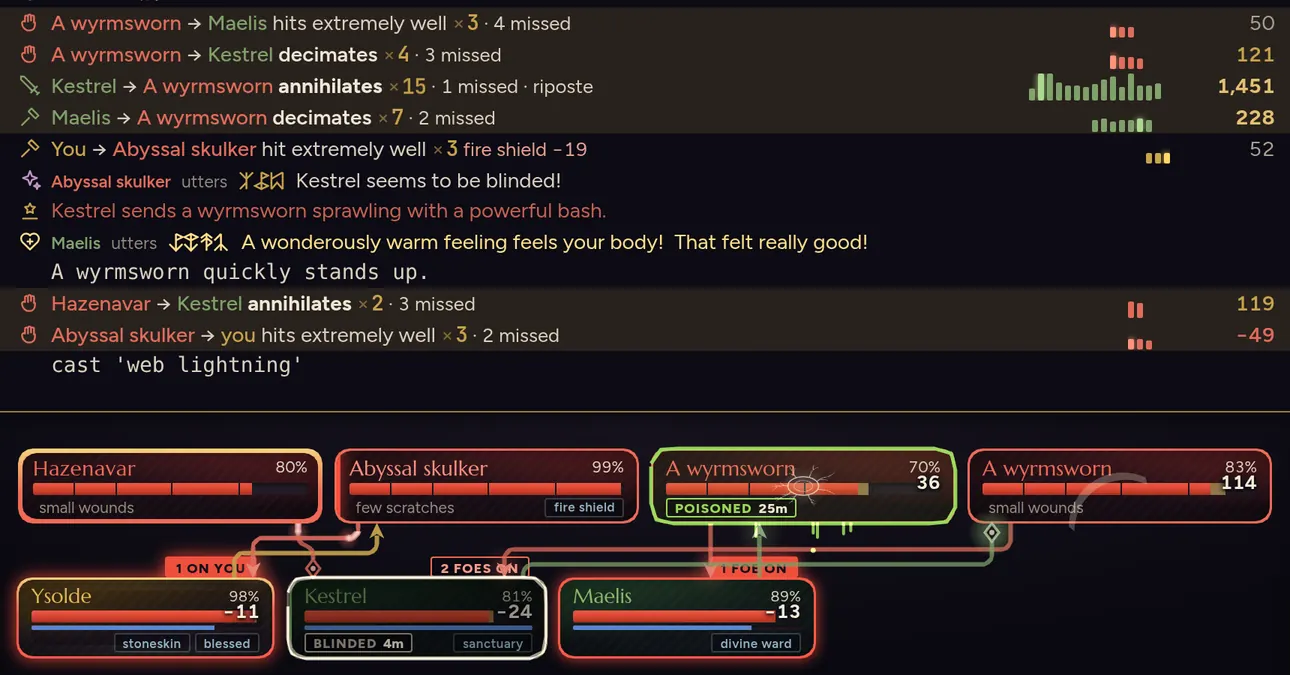
The board sits at the foot of the game window, just above the command line. Above it, the Battle Scribe writes the same fight out in words. The two always agree: the Scribe tells you what happened, the board shows you where.
The board at a glance
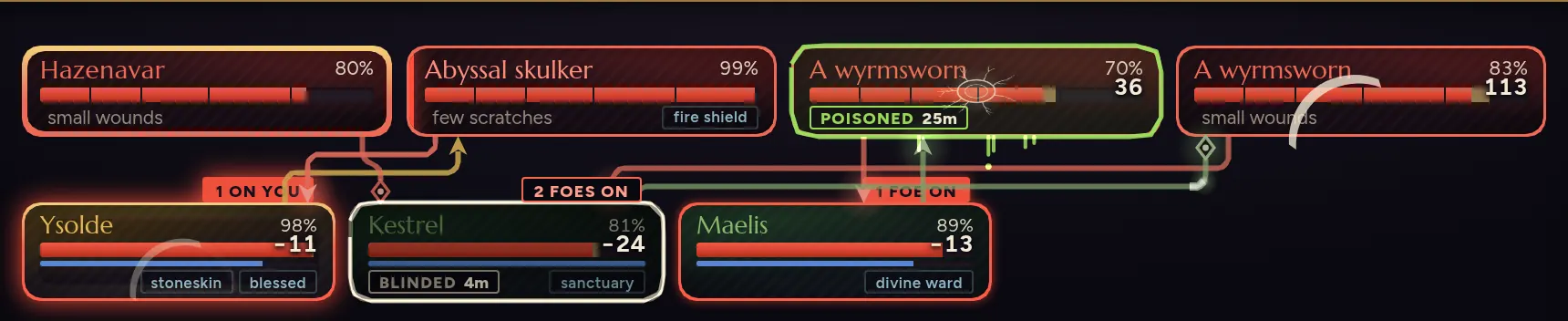
Here is one moment, seventeen seconds into the fight. The numbers are explained below the picture.
 1
2
3
4
5
6
7
8
9
10
11
12
13
14
15
The picture scrolls sideways.
- The foes' row. Everyone fighting against you, in red-edged cards. It appears when a fight starts and goes when the fight is over.
- Your row. Your own card in gold, then your group in green. Your row shows whenever you are grouped, in a fight or not.
- Name and health. The fighter's full name and how much health is left, in per cent.
- The health bar. Always red. Small notches mark a quarter, a half and so on, so you can judge it at a glance.
- The gold trail. The chunk of health just lost shows gold for a moment before it drains away.
- The number. The damage this fighter is taking right now, counting up as blows land.
- The mana line. The thin blue line under the health bar, on your side only.
- How it fares. With nothing on it, a card's status row shows the game's own condition word: excellent, few scratches, small wounds, awful…
- Buffs. Quiet words on the right of the status row: fire shield, sanctuary, stoneskin.
- Debuffs. Chips on the left, each in its own colour with the time left: BLINDED 4m, POISONED 25m.
- A foe on you. A red blade down the left edge of a foe's card means it is attacking you.
- A line ending in an arrowhead. A weapon attack. This gold one is yours: Ysolde is on the Abyssal skulker.
- A line ending in a diamond. A caster's line. Hazenavar has been casting at Kestrel.
- The tag. How many foes are on this fighter, in words, where their lines land.
- A red, pulsing edge and a filled tag. Someone with a foe on them who isn't the one meant to take the hits. They may need rescuing.
Cards and colours
Every fighter gets one card of their own. Four charmed treants are four cards, and two wyrmsworn are two, even with the same name. Cards have no portraits: just the name, the bars and the status row. A name is never cut short; on a crowded board it is set a little smaller instead.
The edge of a card says whose side it is on:
- Gold you
- Green your group
- Red foes
The same three colours are used for the lines, so a gold line is always yours and a red one always a foe's. Your own card is the same size as your friends' cards and is never faded or greyed out, whatever happens. For your exact health and mana numbers, look at your score window; the card keeps to bars so the board stays small.
A card's edge also reacts. It flashes when the fighter is hit, in the colour of what hit it, glows holy gold when it is healed, and takes on a debuff's colour while that debuff's look plays on it.
Health bars
- Health is always red. On every card, friend or foe.
- The bar answers the blow. It drops as each hit lands, not a moment later when the game next reports.
- A gold trail shows the piece just knocked off, then drains away. A big gold trail means a big hit.
- A heal fills its part of the bar in holy gold first, then turns red, while its number counts up.
- A fighter who can't act (stunned, paralyzed, asleep or knocked down) has its bars pushed back and dimmed for as long as it lasts. Your own card is never pushed back.
Numbers and big hits
Each card has one place for numbers, at the right end of its health bar, never over the name. Small blows merge into one number that counts up; a big hit gets its own, larger number. The colour tells you what did it:
- Pale a weapon
- The spell's colour a spell
- Holy gold, with + a heal
On your side the number shows as a loss, like −24; a heal as a gain, like +1840. A miss, dodge or parry is no word at all, just a small sidestep of the card.
How big a hit is depends on the share of the target's health it took, not the raw number. A hit of a fifth of someone's health is huge, whether that is 50 or 5,000. Only the heaviest blow in each quarter of a second gets the full show: the struck card holds still for a tenth of a second, then the chunk falls out of its bar, the card recoils away from its attacker, and the big number appears. A killing blow always gets it.
The lines: who is on whom
For as long as a fight lasts, there is a line from every fighter to whoever they are attacking, on both sides. Follow a line from a foe and you see which of you it is on. Follow yours to see your target.
- Colour is who. A line is in its attacker's side colour: red from a foe, green from your group, gold from you. Yours, and the ones on you, are drawn a little stronger.
- The end is how. Each line ends in a small solid shape, like a charge on a shield, that says what kind of attack it is.
- Lines never cross a card and keep out of each other's way, with square corners, so you can follow each one by eye.
- Lines sit still until something travels along them.
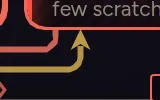 Arrowhead: weapon blows.
 Diamond with a lit eye: a caster who has cast along this line.
 Disc with a cross: a heal.
A skill such as bash or kick ends in a flat bar.
Every attack pulses its line. A plain weapon swing sends a short, faint pulse down the attacker's line, and the end flashes on a hit. A skill, spell or heal sends a bright spark down the line in its own colour, and the end answers when it lands: a slash for a weapon, a spreading ring for a spell, rays of light for a heal, a jolt for a skill.
Short-lived lines. When a spell, heal or skill goes to someone who isn't the caster's usual target (a cleric healing a friend while hitting a foe, say), a line grows out from the caster in that ability's colour, carries it across, lands, and fades.
A change of target (a rescue, a foe turning on someone) shows the old line drawing back into its attacker as the new one grows out to the new target, in under half a second. If a foe turns on you, your card's edge flashes red.
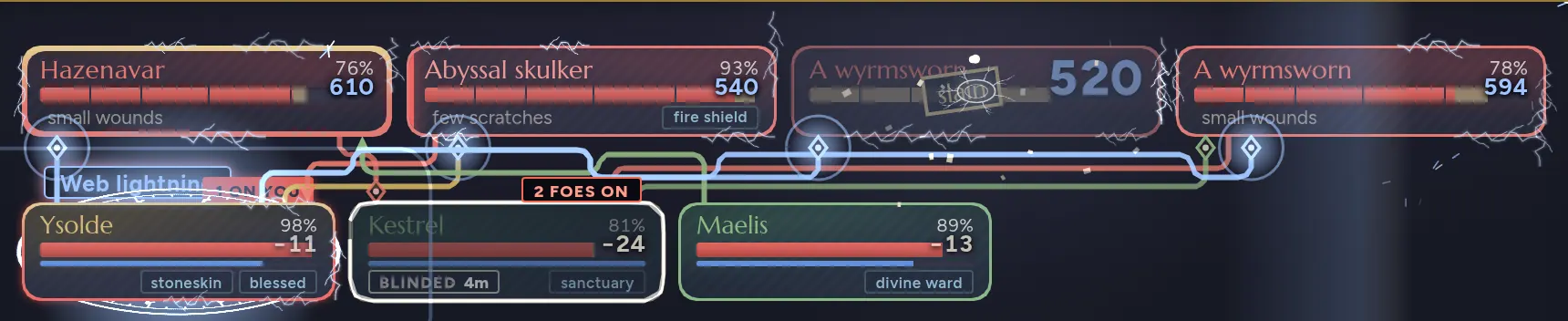
Who needs rescuing
A small red tag on the top edge of a card counts the foes on that fighter, in words: 1 ON YOU, 2 FOES ON. The lines land right there.
The fighter most foes are on is your tank, and that is how it should be. Anyone else on your side with a foe on them stands out: their card's edge pulses red and their tag is filled in solid red. When you see a pulsing red card, a rescue is due.
Spells and heals
- The spell's name appears just above the caster's card, in the spell's colour, and the card glows. That is how you tell who cast what, foes included.
- The effect flies from caster to target along the line, and the target's card answers when it lands.
- Strong spells look stronger. A low-level spell is a small bolt; a high-level one draws a summoning circle round its caster's card, covers more of the target and lights the cards beside it.
- Marks stay a moment. A damaging spell leaves a mark on the struck card for a second or three: charring for fire, rime and ice for cold, pits and drips for acid, arcs along the edge for lightning, a slash scar or a dent for a heavy weapon. After the first half second the mark keeps to the card's edges, so you can still read it.
- A damage shield such as fire shield plays no effect of its own: the attacker's edge flickers in the shield's colour when it gets singed.
The colours of spells, used for their names, their lines and their numbers:
- Fire
- Cold
- Lightning
- Acid and poison
- Holy power divine gold
- Heals holy light
- Other magic violet
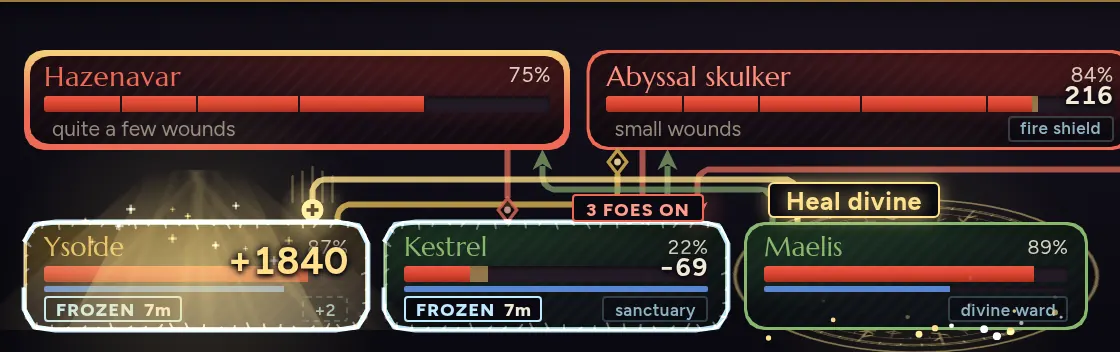
Buffs and debuffs
Under the health bar, every card has a status row. Nothing ever hangs outside the card.
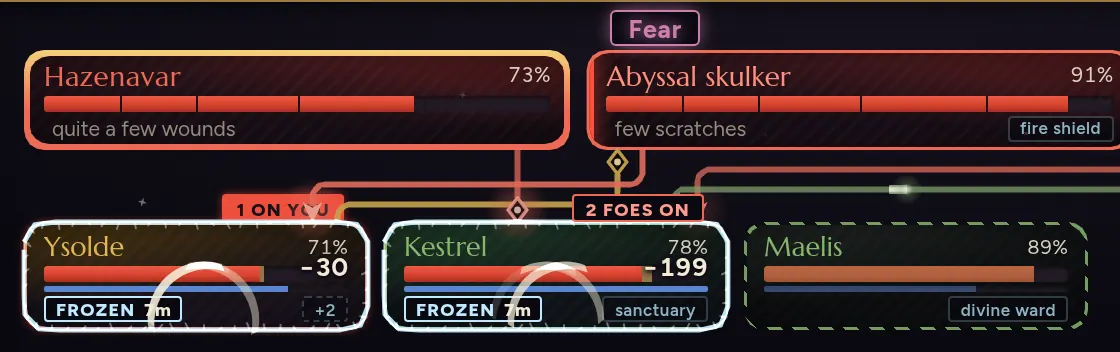
- Debuffs on the left, the most serious first, each as a chip in its own colour with the time left: 42s under a minute, then 7m, then 2h. A debuff the game hasn't timed shows no time.
- Buffs on the right, in smaller, cooler words.
- “+2” means two more than fit.
- As a debuff lands its name flashes across the card in big letters, and its look plays on the card: circling stars, rime, drips, a web, a dark veil. When it lifts, the name shows once more, struck through.
- With no debuffs, the row shows how the fighter is faring, in the game's own words.
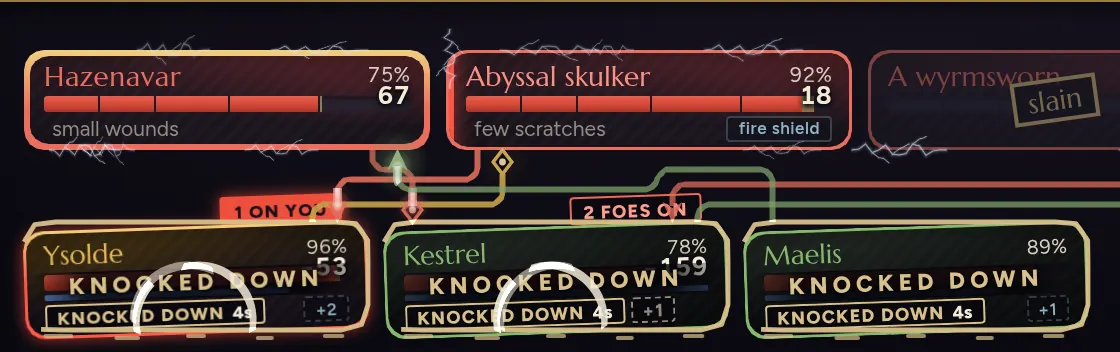
The sixteen debuffs, most serious first, in the colour of their chips. The first four stop the fighter from acting.
- Stunned
- Paralyzed
- Asleep
- Knocked down
- Webbed
- Blinded
- Silenced
- Terrified
- Frozen
- Chilled
- Poisoned
- Bleeding
- Cursed
- Weakened
- Charmed
- Faerie fire
What each buff and debuff does, and which spell gives it, is on Buffs and debuffs.
Kills and deaths
- The kill. On the killing blow the card freezes, its bar empties, slain stamps down across it and a bright cut throws fragments off it. The lines at it pull back to their owners. If the kill is yours, your card glints gold.
- Then it goes. The slain card fades and folds away, and its neighbours slide over to close the gap.
- The last foe holds a second longer, and the board's top edge turns gold: the fight is won.
- A friend's death gets the same stamp. Their card keeps its place, slain, until they are back or the fight is over.
- Your own death is told by the game's text, not the board. Your card is never stamped or faded.
Comings and goings
A friend who flees or walks out of the room keeps their card, but its edge turns dashed and its bars go hollow. Hold the pointer over it to see where they are. When they come back, a light runs once round the card and it is whole again. Foes who arrive slide in to the foes' row; foes who leave fold away.
Big fights
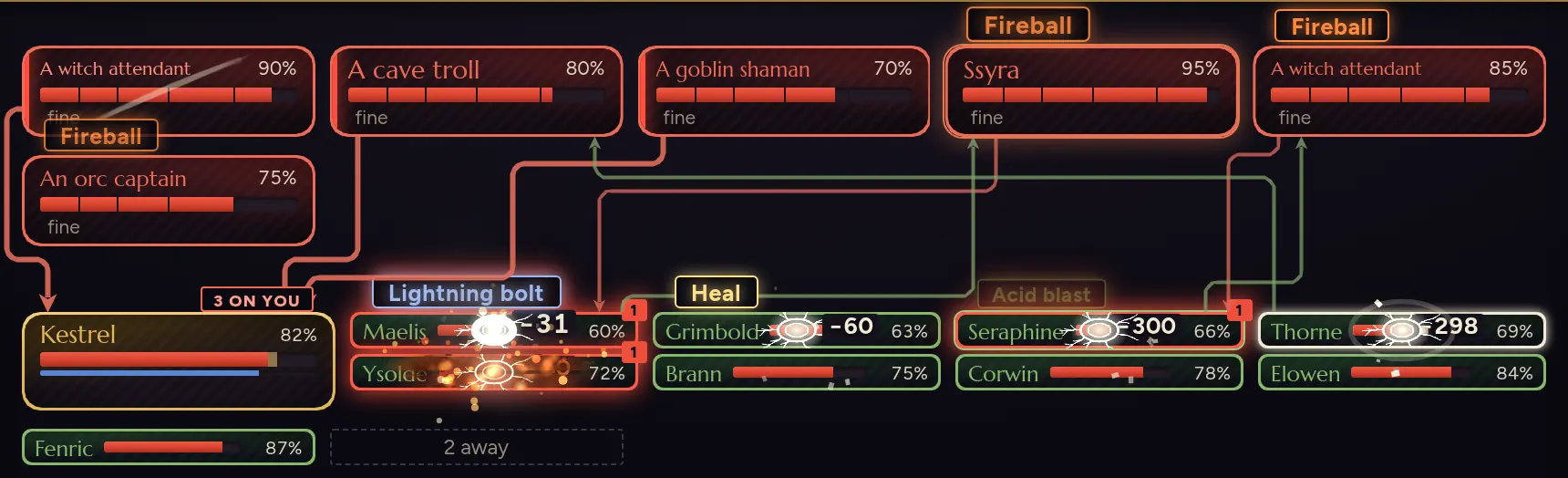
The board keeps its shape when a fight gets crowded:
- More than five in your group: your friends become one-line strips with just the name and the health bar, flowing beside and under your card. Their tags shrink to a number.
- Friends elsewhere fold into one “2 away” chip. Click it to open them.
- Lots of foes: the ones attacking you come first. Past two rows the rest fold into “+N more”, which also opens with a click.
- More than nine cards: lines that aren't yours are drawn thinner. A line is never hidden.
Reading a fight, moment by moment
Four moments from the dragon's lair, and what the board is telling Ysolde at each.
1. The fight opens
Seven seconds in
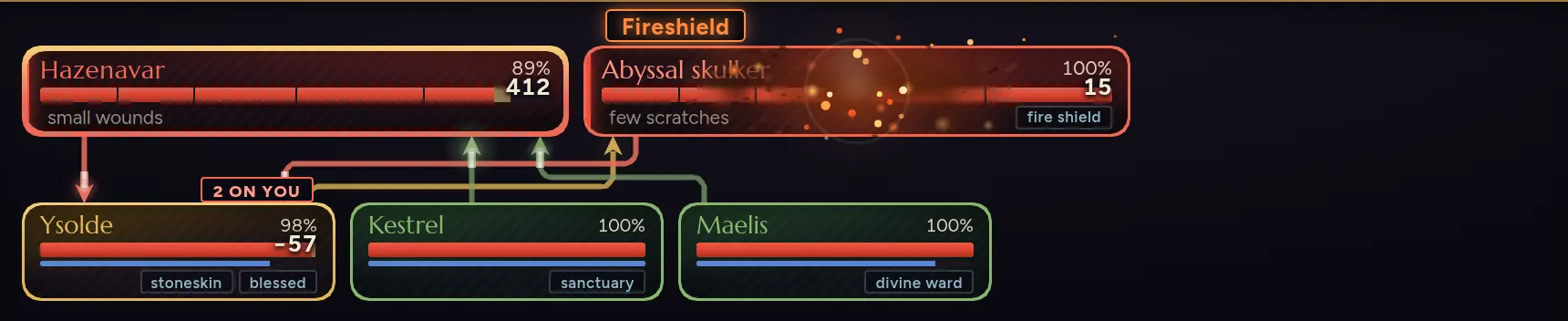
- Who is on her: 2 ON YOU, and two red lines come down to her card. Both foes are on the mage, which is wrong.
- What the foes are doing: Fireshield over the skulker. Its card now says fire shield: anyone who hits it gets singed.
- Who is winning: 412 on Hazenavar and a gold trail on his bar: the group is hitting him hard.
2. Bash and blindness
Fourteen seconds in
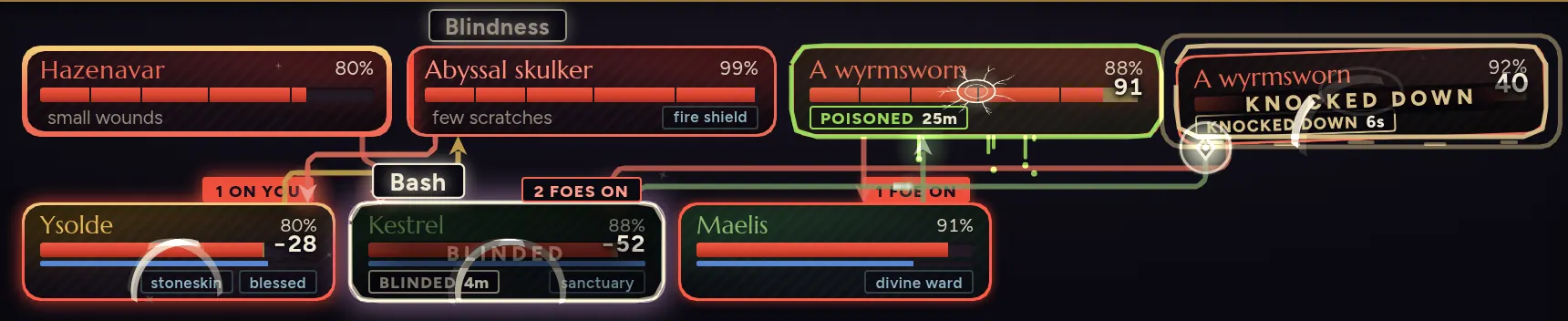
- Kestrel took the dragon off her: Ysolde's tag is down to 1 ON YOU, Kestrel's says 2 FOES ON.
- Two things within a second: Bash over Kestrel, and a wyrmsworn knocked down for six seconds. Then Blindness over the skulker, and BLINDED across Kestrel's card, for four minutes.
- Ysolde's own work: the green-lit wyrmsworn is poisoned, with 25 minutes to run.
3. The first kill
Eighteen seconds in
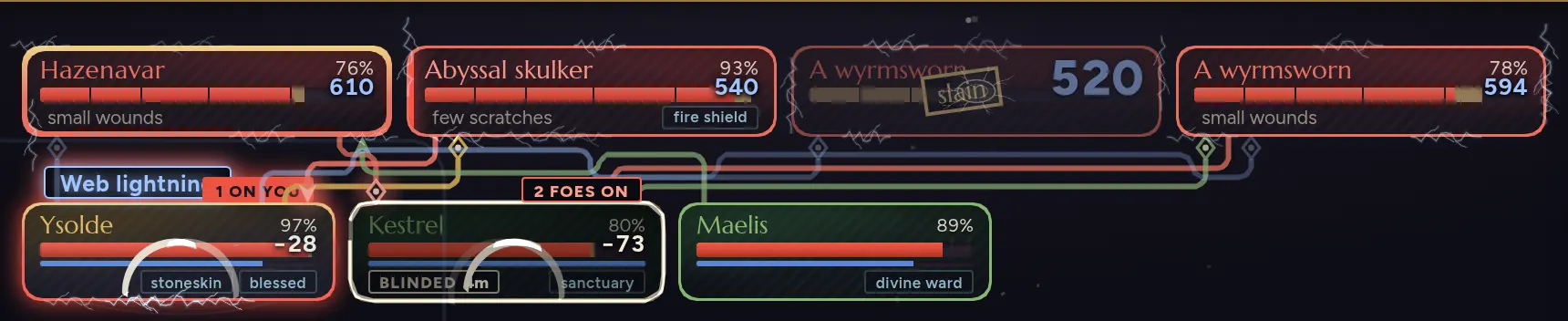
- The spell: Web lightning over Ysolde, blue numbers on every foe. It hit the whole room.
- The kill: the poisoned wyrmsworn is grey and stamped slain. In a moment its card folds away and the last wyrmsworn slides over.
- The warning: Ysolde's edge glows red. Something is still on her, and she isn't the tank.
4. The dragon falls
Eighty-four seconds in
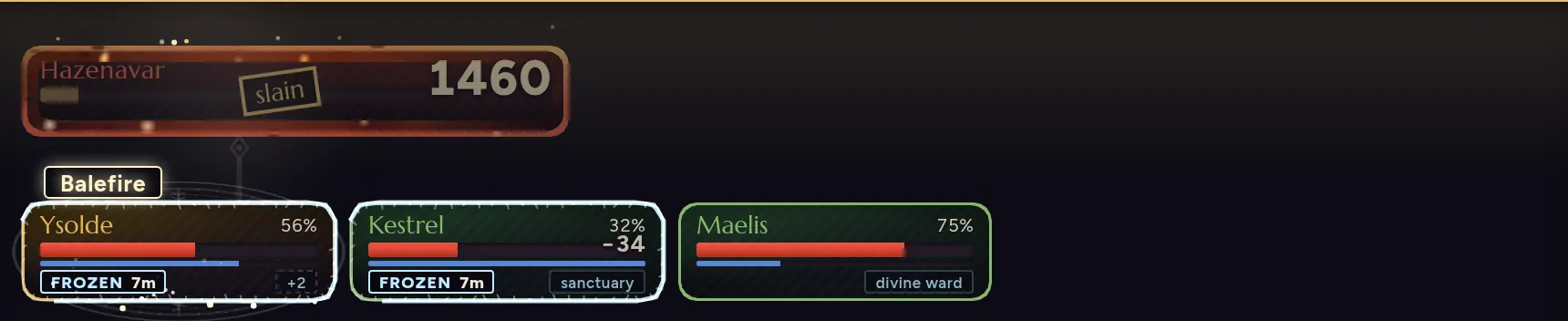
- The killing blow: Balefire over Ysolde, 1460 on the dragon, and slain.
- It's over: no lines are left, because no one is fighting. Hazenavar was the last foe, so his card holds a little longer and the top edge turns gold.
- The cost: Kestrel at 32%. Time to rest.
Watch a whole fight
The whole fight in the real client, with the Battle Scribe above the board. It runs for about a minute and a half.
To see the same fight beside what a telnet client prints, line for line, go to One fight, two ways.
Settings
In Arcana, Settings › Combat has these switches:
- Battle Board, on from the start. Off, you get the plain health bars and target list instead.
- Battle Scribe, on from the start. Its own page: the Battle Scribe.
- Calm combat effects. Nothing flies, pulses or shakes: an effect is a brief touch of colour on the card's edge, numbers appear in place, and debuff looks stand still. Names, the status row and the bars work as usual, and the lines keep their places; nothing runs along them. Calm is always on when your system asks for reduced motion.
Arcana's Map shows where you are. The Battle Board shows who you're up against.
Arcana is free and runs in your browser. Play now, or read more about Arcana.